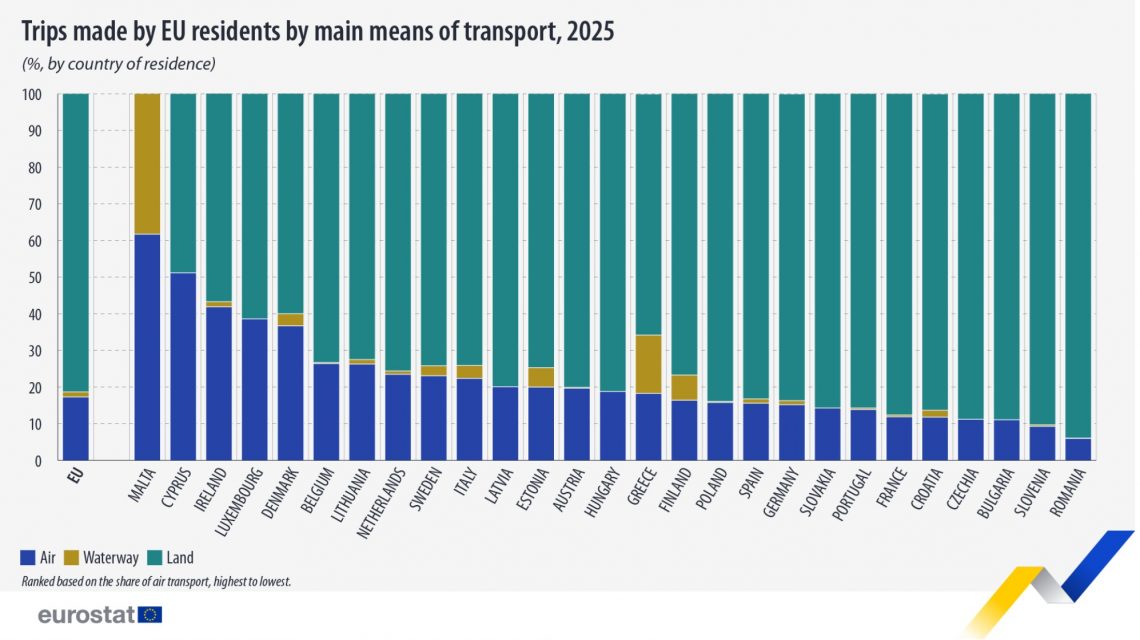
Malta recorded the highest proportion of air travel among European Union countries in 2025, according to recently released statistics published by Eurostat on 19 November 2026. Air travel accounted for 61.6% of overnight trips made by Malta residents, significantly above the EU average of 17.2%.
The findings highlight the importance of international connectivity for island nations and Malta’s position as a Mediterranean base for residents, businesses and internationally mobile families.
Malta Records the EU’s Highest Share of Air Travel
According to Eurostat, EU residents made approximately 1.2 billion overnight trips in 2025, with land transport remaining the most common means of travel across the European Union.
Of these journeys, 81.4% were undertaken by land, 17.2% by air and 1.4% by waterways.
However, the recently released figures reveal a different pattern among Europe’s island nations, where air travel plays a considerably greater role.
Malta recorded the highest proportion of air travel at 61.6%, followed by Cyprus at 51.1% and Ireland at 41.8%. Luxembourg and Denmark also recorded relatively high shares, at 38.5% and 36.6%, respectively.
Malta also registered the EU’s highest proportion of travel by waterways, accounting for 38.4% of trips made by its residents. Greece followed at 15.9% and Finland at 6.9%.
These figures demonstrate the importance of air and maritime transport for island populations, where international travel depends heavily on connections beyond national borders.
Source: Eurostat – Air travel made up 17.2% of trips in 2025, published 19 November 2026.
Malta’s International Connectivity and Strategic Mediterranean Location
Situated in the heart of the Mediterranean, Malta occupies a strategic geographical position between mainland Europe and North Africa, with connections to major European cities and international transport hubs.
Malta International Airport serves as the country’s principal aviation gateway, supporting international travel for residents, businesses sitors.
The country’s international connectivity has continued to develop, with passenger traffic increasing during 2026. As highlighted in our earlier article, Malta Airport Passenger Numbers Surge as International Appeal Grows, Malta International Airport welcomed more than 1.2 million passengers in August 2026 alone, representing an increase of more than 12% compared with August 2025.
For individuals and families maintaining personal, professional or business interests across multiple countries, access to international transport is an important consideration when deciding where to establish a residence.
Malta’s geographical location, combined with its membership of the European Union, Schengen Area and eurozone, contributes to its appeal as a European base for internationally mobile individuals.
Why International Connectivity Matters for Families and Businesses
For families considering relocating to Malta, international accessibility can be an important part of long-term planning.
Frequent travel may be necessary for business commitments, family visits, education or maintaining connections with other countries. Convenient access to European destinations can help families balance these commitments while establishing a home in Malta.
Business owners and entrepreneurs may also value the ability to travel internationally while maintaining their personal or professional base on the island.
Alongside connectivity, Malta offers an English-speaking environment, an established international business community, educational opportunities, healthcare services and a Mediterranean lifestyle.
For those considering a move, Vertex Alliance provides comprehensive private client relocation services, including property assistance, school and education support, and practical guidance on settling into life in Malta.
Malta as a European Base for Internationally Mobile Families
For non-EU nationals exploring European residence options, Malta offers several residence frameworks, including the Malta Permanent Residence Programme (MPRP), subject to the applicable eligibility and application requirements.
The MPRP provides qualifying non-EU nationals and eligible family members with the opportunity to obtain permanent residence in Malta through a regulated application process.
As Malta forms part of the Schengen Area, qualifying Maltese residence permit holders may also travel to other Schengen countries for short stays of up to 90 days within any 180-day period, subject to the applicable entry conditions.
However, permanent residence in Malta does not automatically provide the right to live or work in another EU country.
For families exploring their options, our article Why the Maltese MPRP Programme Appeals to Families Seeking Permanent Residence in Europe explains the programme’s benefits, eligibility requirements, family inclusion and property options.
Internationally mobile individuals may also wish to understand the wider travel opportunities available within Europe. Our guide, Which 29 Countries Are in the Schengen Area in 2026?, provides further information about Schengen membership and short-term travel arrangements.
What the Recently Released Eurostat Figures Tell Us
The Eurostat statistics relate to overnight trips undertaken by EU residents aged 15 and over for personal or professional purposes. They measure the principal means of transport used for these journeys, rather than international visitor arrivals or total airport passenger movements.
The figures therefore do not indicate that 61.6% of visitors to Malta arrived by air. Instead, they show that air travel accounted for 61.6% of overnight trips made by people residing in Malta.
Nevertheless, the findings highlight the significant role that international transport plays in the travel patterns of Malta’s resident population.
For individuals and families considering Malta as a long-term European base, connectivity remains one of several important factors alongside residence rights, lifestyle, education, property and financial planning.
How Vertex Alliance Can Help
Vertex Alliance provides tailored advisory services to international individuals and families considering residence, property investment and relocation to Malta. As a licensed agent of the Residency Malta Agency, our team assists clients with the Malta Permanent Residence Programme, from assessing eligibility and preparing applications to providing practical relocation and property-related support.
Whether you are exploring Malta as a permanent home or considering establishing a European base for your family, our experienced team can help you understand the available options and plan your next steps.
Contact Vertex Alliance to discuss your Malta residency and relocation requirements with our team.
Frequently Asked Questions About Travelling to Malta
Visa requirements depend on your nationality and the purpose and duration of your visit. Malta is part of the Schengen Area, meaning travellers from certain countries can visit visa-free for short stays, while others must obtain a Schengen visa before travelling. Non-EU nationals should check the applicable entry requirements before departure.
Malta is a member of the Schengen Area, which currently comprises 29 European countries. Travellers holding a valid Maltese residence permit can generally visit other Schengen countries for up to 90 days within any 180-day period without obtaining an additional short-stay visa, subject to applicable conditions. Travel to European countries outside the Schengen Area may require separate entry permission.
Malta International Airport, located in Luqa, is the country’s only international airport. It provides connections to numerous European destinations and international transport hubs, supporting travel for tourists, residents and business visitors.
Yes. Malta has international ferry connections, including services linking Malta with Sicily. Domestic ferry services also operate between Malta and Gozo, providing an important transport connection for residents and visitors. Routes and schedules vary by operator and season.
Yes, provided you meet the relevant entry requirements. Visiting Malta before making a longer-term residence decision can help you explore different locations, assess property options, visit schools and experience everyday life on the islands. However, visiting as a tourist does not automatically grant residence rights. Individuals considering permanent residence should review the available programmes and eligibility requirements before applying.