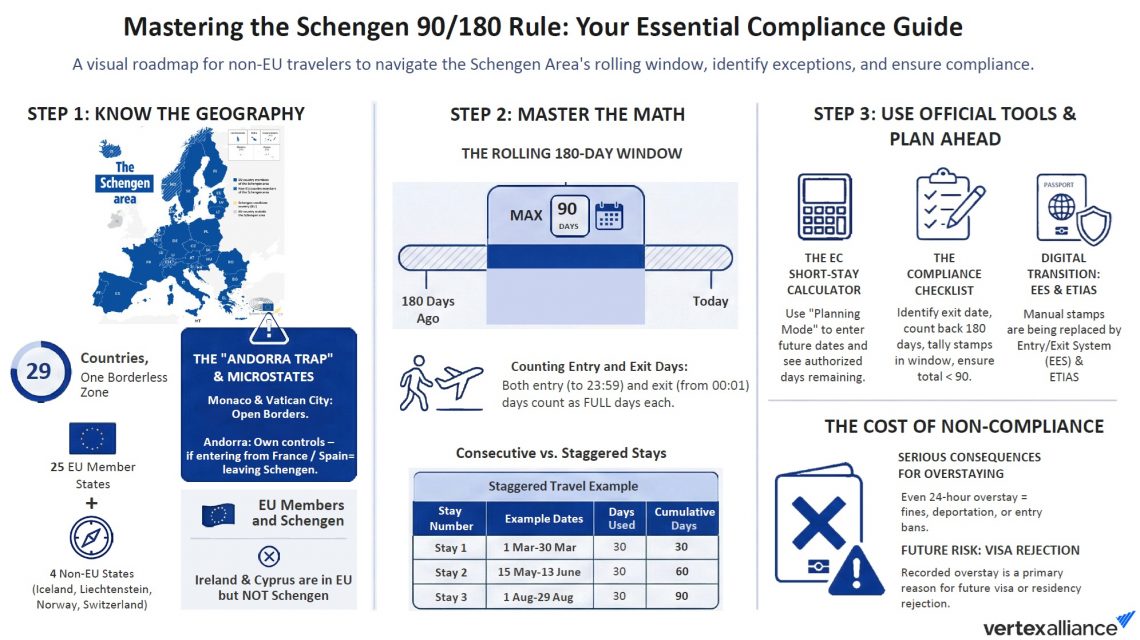
As a traveller navigating the complexities of European mobility, you may find yourself planning a month of client meetings in Berlin, followed by a coastal retreat in Spain and a winter holiday in Rome. While the Schengen Area offers the convenience of border-free travel, it is governed by a rigid and often misunderstood regulatory framework: the “90/180-day rule.” Because the 180-day reference period is a “rolling window” that must be satisfied for every single day of your stay, even the most seasoned travellers risk an accidental overstay. If the 90-day limit is exceeded, this may be treated as an overstay or an irregular stay. Enforcement can include fines, removal orders, and in some cases entry bans, depending on the country and circumstances. This guide serves as your authoritative resource for remaining compliant, utilizing only official European Commission data and updated regulatory standards.
Your Essential Schengen Guide
The Schengen Area is an area currently comprising of 29 European countries that, for international travel purposes, have abolished internal border controls. This allows for seamless transit across the region without identity checks at common borders.
Please note that, in exceptional circumstances, Schengen countries may temporarily reintroduce internal border controls for security or public order reasons, such as major international events or heightened security situations.
Current Members and Status
- 25 EU Member States: Includes major destinations like France, Germany, and Italy. Of particular note, Bulgaria and Romania are the newest full members; while air and sea border controls were lifted in early 2024, land border controls were officially abolished on January 1, 2025.
- 4 Non-EU States: Iceland, Liechtenstein, Norway, and Switzerland. These are members of the European Free Trade Association (EFTA) that have signed association agreements to participate in the Schengen acquis.
Important Exceptions and The “Andorra Trap”
It is critical to distinguish between the European Union and the Schengen Area. Ireland and Cyprus are EU members but are not part of Schengen. In Cyprus’ case, the Schengen integration process is ongoing and internal border controls have not yet been lifted.
Furthermore, travellers must be wary of European microstates. While Monaco, San Marino, and Vatican City are not part of Schengen, they have open borders with neighbouring Schengen states in practice. Andorra is different: it maintains its own border controls. Entering Andorra from France or Spain is treated as leaving the Schengen Area, so if you hold a single entry Schengen visa, a visit to Andorra can prevent you from re-entering Schengen afterwards. In such cases, you may need a double entry or multiple entry Schengen visa depending on your travel plan.
Practical Takeaway #1: Schengen is about border-free travel, but it isn’t the same as the EU. Always verify the status of your destination—and any microstates you plan to visit—before you fly.
Short-stay visitors are permitted to stay in the Schengen Area for a maximum of 90 days within any 180-day period, calculated by counting back 180 days and ensuring the total does not exceed 90.
If you use the full 90 days, you can only return once enough earlier days fall outside the rolling 180-day window. In practice, the “time outside” required depends on your travel history.
Practical Takeaway #2: Think of it as a sliding window: at any given moment you are in Europe, you must look back at the last 180 days. That tally can never cross 90.
The 90/180-day limit applies to all “third-country nationals” (those from outside the EU/EEA/Switzerland), including:
- Visa-Exempt Nationals: Citizens of countries like the United Kingdom, United States, Canada, and Australia.
- Visa-Required Nationals: Holders of a short-stay (Type C) Schengen visa.
Exemptions: If you hold a valid residence permit issued by a Schengen country, you may travel visa free to other Schengen countries for short stays. In that case, the 90 days in any rolling 180 day period rule applies to time spent in other Schengen countries, outside your country of residence. Time spent in your country of residence is not counted towards the 90 days limit, as you may stay there an unlimited number of days for as long as your residence status remains valid.
The “rolling window” is a moving reference period. To be compliant, you must satisfy the requirement every day you are in the territory.
Calculation Logic
- Day of Entry: The first day of stay (even if you enter at 23:59).
- Day of Exit: The last day of stay (even if you leave at 00:01).
Real-World Scenarios
The Compliant Stay:
You enter on January 10 and exit January 20 (11 days used). You return on March 5. At that point, you have 79 days of your 90-day allowance remaining (assuming no other Schengen stays in the preceding 180 days).
The Full Allowance Stay:
You stay 90 consecutive days from 1 March to 29 May (90 days). Having fully used your allowance, you must leave the Schengen Area and can only return once enough of those earlier days fall outside the rolling 180 day window. In this example, the earliest re entry becomes possible on 28 August.
In this scenario, the 180 day reference period starting on 1 March runs until 27 August. The first day of stay (1 March) falls outside the 180 day window on 28 August, meaning 28 August is the earliest date on which re entry becomes possible, provided no other Schengen days were used in the meantime.
Staggered Travel Example:
You spend 30 days from 1 March to 30 March, exit the Schengen Area, then return for 30 days from 15 May to 13 June, and later return again for 30 days from 1 August to 29 August.
Each stay is permitted because, on every day of entry, the total number of days spent in the Schengen Area during the preceding 180 days never exceeds 90 days. Earlier days progressively fall outside the rolling 180 day window, freeing up new days for subsequent travel.
This illustrates that the 90 days do not need to be used consecutively. What matters is the cumulative total within any rolling 180 day period, calculated on a day by day basis.
|
Stay |
Dates in Schengen |
Days Used |
Cumulative Days in Last 180 |
|
1 |
1 March – 30 March |
30 |
30 |
|
2 |
15 May – 13 June |
30 |
60 |
|
3 |
1 August – 29 August |
30 |
90 |
How this works:
On each entry, the total number of days spent in the Schengen Area during the preceding 180 days remains within the 90 day limit. As time passes, earlier days drop out of the rolling 180 day window, allowing new stays without breaching the rule.
Your Planning Checklist
- Identify your intended exit date.
- Count back exactly 180 days from that date.
- Tally all previous entries/exits within that 180-day window (consulting your passport stamps).
- Confirm the total is 90 days or fewer.
Practical Takeaway #3: While passport stamps are currently the primary evidence used by border guards, be prepared for the Entry/Exit System (EES). Implemented on 12 October 2025, the EES is being introduced gradually, with full implementation scheduled for 10 April 2026, this automated system will replace manual stamping with biometric facial and fingerprint registration.
Exceeding the limit is treated as an overstay and may lead to enforcement action, with consequences depending on the member state and circumstances. Enforcement is strict and can result in:
- Monetary Fines: Administrative penalties that vary by member state.
- Entry Bans: A formal prohibition from re-entering the Schengen Area for a set period.
- Expulsion: Deportation from the territory.
- Visa Rejection: A recorded overstay is a primary ground for the rejection of future visa or residency applications.
Practical Takeaway #4: An accidental overstay of even 24 hours, can cause serious issues (fines, refusal of entry, and possible entry bans), depending on the country and circumstances.
The European Commission provides an official tool to assist with these calculations.
Link: European Commission Short-stay Calculator
How to Use the Tool
- Check Mode: Used to verify if past or current stays are compliant.
- Planning Mode: Allows you to enter a future entry date to see how many days will be authorized for that specific trip.
- Input Tips: Dates must be entered as dd/mm/yy.
- The “Passport” Button: Primarily designed for border guards, this allows you to enter entry/exit dates in random order (as they might appear in a passport). Use “+” for entry (e.g., +010125) and “-“ for exit (e.g., -100125); the calculator will automatically pair them.
Future Requirement: Starting in late 2026, visa-exempt nationals (including UK and US citizens) will also need an ETIAS (European Travel Information and Authorisation System) authorization to enter, which will be valid for three years.
Practical Takeaway #5: The calculator is a guidance tool only. It does not grant a legal right to stay; the final decision on entry and duration always rests with the individual border guard.
Conclusion
Mastering the 90/180 rule is the “golden rule” of European travel compliance. While the sliding window can be daunting, it is manageable through proactive record-keeping. We recommend maintaining a personal travel log or a dedicated app to double-check your history against the European Commission’s official calculator before every journey. In the era of increasing digital surveillance and the EES, precision is your best defence against travel disruptions.
Written by Alexandra Kenna, Senior Consultant at Vertex Alliance, get in touch akenna@valtd.com.