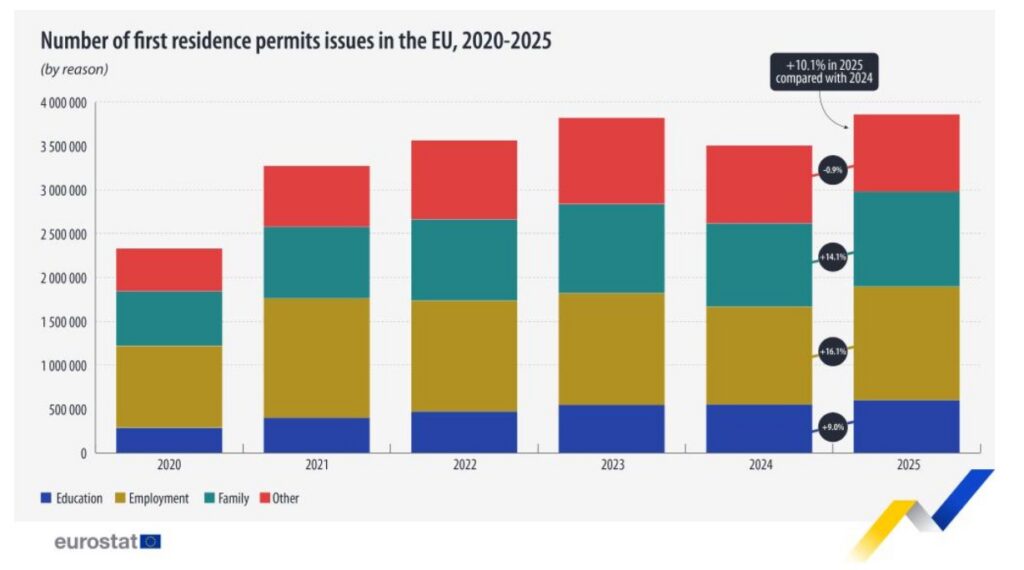
The European Union issued approximately 3.9 million first residence permits to non-EU citizens in 2025, representing an increase of 10.1% compared with the previous year, according to the latest annual statistics published by Eurostat on 11 September 2026.
The increase of 355,350 permits brings the total to its highest level since records began in 2008, highlighting the continued importance of European residence for international workers, families, students and individuals pursuing other forms of long-term residence.
Employment remained the leading reason for new residence permits, followed by family reunification and education. Alongside these traditional routes, investment-based residence programmes continue to provide an alternative for qualifying individuals and families seeking to establish a European base.
Employment and Family Reunification Drive EU Residence Permits
According to Eurostat, the 3.9 million first residence permits issued in 2025 were distributed across four principal categories:
- Employment: 1.3 million permits, representing 33.6% of the total.
- Family reasons: 1.1 million permits, accounting for 28.1%.
- Other reasons, including international protection: 0.9 million permits, representing 22.8%.
- Education: 0.6 million permits, accounting for 15.5%.
Employment-related permits increased by 16.1% compared with 2024, while family-related permits rose by 14.1%. Education-related permits also increased by 9.0%.
By contrast, permits issued for other reasons, including international protection, declined slightly by 0.9%.
These figures demonstrate the diverse reasons non-EU nationals establish residence in Europe, from employment opportunities and family reunification to higher education and other personal circumstances.
Source: Eurostat – First residence permits issued in EU up by 10% in 2025, published 11 September 2026.
Which European Countries Issued the Most Residence Permits?
The Eurostat figures reveal significant differences in the number of first residence permits issued across EU Member States.
Spain issued the highest number in 2025, with 635,438 permits, representing 16.5% of the EU total.
Germany followed with 605,292 permits, while Poland issued 467,314, Italy 433,099 and France 377,462.
Together, these five countries accounted for approximately 65.2% of all first residence permits issued across the European Union.
Portugal also recorded a particularly notable increase, with first residence permits rising by 154.9%, from 121,872 in 2024 to 310,639 in 2025.
However, these figures reflect a wide range of residence categories and should not be interpreted as direct indicators of demand for investment-based residence programmes.
Malta Records the EU’s Highest Ratio of Valid Residence Permits
Malta stands out in Eurostat’s separate statistics on valid residence permits held by non-EU citizens at the end of 2025.
The country recorded 230 valid residence permits per 1,000 inhabitants, the highest ratio in the European Union, followed by Cyprus at 204.
Malta also registered a 12.3% increase in its total stock of valid residence permits compared with the end of 2024.
These figures reflect the significant presence of non-EU nationals within Malta’s resident population, including individuals living in the country for employment, family, education and other purposes.
Malta’s position as an English-speaking EU Member State, its established international business environment, Mediterranean lifestyle and membership of the Schengen Area contribute to its appeal among internationally mobile individuals and families.
For those exploring longer-term residence options, Malta also offers dedicated frameworks such as the Malta Permanent Residence Programme (MPRP).
Understanding the Different Routes to European Residence
European countries offer several routes through which eligible non-EU nationals may obtain residence permits. Although these routes can provide opportunities to establish a life in Europe, their eligibility requirements, residence rights and long-term benefits vary considerably.
Employment-Based Residence
Employment remains the largest category of first residence permits issued across the EU.
These permits generally allow qualifying non-EU nationals to reside and work in a particular country, often subject to employment contracts, salary thresholds or employer sponsorship.
Depending on the national framework, continued residence may be linked to maintaining qualifying employment.
Family Reunification
Family-related residence permits allow eligible relatives to join or remain with family members who already have qualifying residence rights in an EU country.
The requirements differ between Member States and may depend on the sponsor’s residence status, financial resources, accommodation and the relationship between family members.
Education-Based Residence
European universities and educational institutions continue to attract international students seeking academic qualifications and professional development.
Student residence permits are generally linked to enrolment in an approved educational institution and may include conditions relating to financial resources, health insurance and permitted employment.
Investment-Based Residence
Investment-based residence programmes provide a separate route for eligible non-EU nationals who meet specific financial, investment and due diligence requirements.
Unlike conventional employment-based residence, these programmes generally do not require applicants to secure a local employment contract.
Depending on the country, qualifying investments may involve property acquisition, investment funds, business activities or other approved economic contributions.
Some programmes also provide opportunities to include eligible family members and may offer relatively flexible physical-presence requirements.
Importantly, investment-based residence programmes represent only one part of Europe’s broader residence landscape. Eurostat’s headline statistics do not separately identify the number of permits issued through these programmes, and the overall increase should not be interpreted as evidence of equivalent growth in investment migration.
European Residence by Investment: Malta, Greece and Portugal
For internationally mobile families considering European residence through investment, Malta, Greece and Portugal offer different frameworks.
Malta Permanent Residence Programme
The Malta Permanent Residence Programme (MPRP) provides qualifying non-EU nationals and eligible family members with permanent residence in Malta from the outset, subject to the programme’s requirements.
Applicants must satisfy financial eligibility criteria, meet qualifying property requirements and complete the relevant government contributions, fees and due diligence procedures.
The programme offers the option of renting or purchasing qualifying residential property and does not impose a minimum annual physical-presence requirement to retain permanent residence, provided all applicable conditions continue to be satisfied.
Greece Golden Visa
Greece offers a renewable five-year residence permit through qualifying investments, with real estate remaining a principal investment option.
The applicable property investment threshold depends on the location and investment category.
The programme generally does not require investors to reside in Greece for a minimum number of days each year to maintain their investor residence permit, subject to the relevant renewal requirements.
Portugal Golden Visa
Portugal’s Golden Visa programme offers qualifying non-EU nationals a residence route through approved investments, including eligible investment funds, research, cultural activities and certain business-related options.
Direct and indirect real estate investments no longer qualify under the programme.
The framework includes relatively limited minimum-stay requirements and may provide opportunities to apply for permanent residence or citizenship in the future, subject to the separate legal conditions applicable at the time.
For a more detailed comparison of these three European residence options, read our article: Malta, Greece or Portugal: Which European Residence Option Is Right for You?.
Why Families Are Considering Long-Term European Residence
Beyond the immediate purpose of obtaining a residence permit, many internationally mobile families consider broader objectives when evaluating where to establish a European base.
These may include access to education and healthcare, international business opportunities, family security, lifestyle preferences and the flexibility to maintain connections across several countries.
For some families, the ability to include dependent relatives or establish permanent residence without immediately relocating is an important consideration.
Others may prioritise property ownership, business expansion or the possibility of pursuing longer-term residence rights.
However, European residence programmes are not interchangeable. The right to reside in one EU country does not automatically grant permission to live or work in another Member State.
Likewise, residence permits and citizenship are legally distinct, and eligibility for naturalisation depends on separate national requirements.
For more information on travel rights, our guide Which 29 Countries Are in the Schengen Area in 2026? explains the Schengen Area, its Member States and the short-term travel rules applicable to residence permit holders.
What Do the Eurostat Figures Mean for European Residency?
The latest Eurostat statistics demonstrate the scale and diversity of residence across the European Union.
With 3.9 million first residence permits issued in 2025 and 27.8 million valid permits held by non-EU nationals at year-end, European residence continues to play a significant role in international employment, family life, education and mobility.
While employment and family reunification account for the largest shares of new permits, investment-based residence programmes provide an additional option for qualifying applicants whose objectives and circumstances differ from those of traditional employment or education applicants.
For internationally mobile families, the decision is not simply about obtaining a residence permit. It involves understanding the rights, obligations, financial commitments and longer-term opportunities associated with each available route.
How Vertex Alliance Can Help With Residency in Europe
Vertex Alliance provides tailored advisory services to international individuals and families exploring residence, property investment and relocation opportunities in Malta.
As a licensed agent of the Residency Malta Agency, our experienced team assists clients with the Malta Permanent Residence Programme, including eligibility assessments, application preparation, qualifying property requirements and practical relocation support.
Our Private Client Relocation Services also provide assistance with property searches, education and school selection, and other practical arrangements involved in establishing a home in Malta.
Whether you are considering establishing a permanent home in Malta or exploring European residence options for your family, our team can help you understand the available pathways and identify a solution aligned with your personal objectives.
Contact Vertex Alliance to discuss your European residency requirements and arrange a consultation.